[Case 03]
Transforming "AI + Me" from a classroom curriculum into a self-paced learning modules

[Industry]
EdTech
[My Role]
UX research
Learning design
UX design
[Platforms]
APP
[Timeline]
Jul -Aug, 2022
[Project Overview]
"AI + Me" is a learning resource designed to help learners explore key concepts of Artificial Intelligence (AI), as well as assist teachers in delivering AI lessons.
Given the growing popularity of AI courses, these materials are ideally suited for use in a self-directed online course. My goal is to transform these materials into an interactive and comprehensive online learning experience, making AI accessible to a wider audience and empowering learners to study at their own pace.
[01. Understanding the context]
ReadyAI is an education technology company that develops AI curriculum resources and training programs for K–12 schools and educators. During my internship, ReadyAI explored turning its classroom curriculum into a self-paced mobile experience for young learners. To test the idea, the team piloted "AI + Me", a 2020 curriculum used by over 10,000 people.
My role was to translate the existing learning materials into interactive app-based modules. I worked closely with the curriculum creator, who served as both the subject matter expert and project mentor. The project was completed within a 4-week timeframe, during which I designed the first version of the learning modules.

[02. Analyzing the current curriculum]
The curriculum works in teacher-led environments, but breaks in self-paced environments.
I started my analysis from the survey responses. User feedback indicated that the curriculum was well received by educators, particularly for its clear explanations and use of real-world examples that made abstract AI concepts easier for children to understand.
However, the same feedback also revealed limitations in how the content performed in a self-paced context. Without teacher facilitation, learners were less engaged, found some sections repetitive, and experienced abrupt transitions in evaluation activities.
★★★★★
The lessons are clear, engaging, and easy for teachers to use.
– User 1
★★★★★
Going through AI + ME courses will surely help learners to understand AI concepts in most simplest way.
– User 2
★★★★★
The content is informative but I wish there were more interactive elements to keep kids engaged.
– User 3
★★★★★
It may be boring for kids to read. The short tests are okay but I feel some of them are repeated.
– User 4
Rather than treating these as isolated issues, I then analyzed the curriculum through a learning design lens. This helped surface a key underlying insight: the original materials were designed primarily for teacher-led instruction, not independent learning.
[03. From curriculum to digital learning design]
Transforming a teacher-led curriculum into a self-paced learning experience required more than redesigning individual lessons. I needed to consider the learning experience as a system—from motivating learners to continue, to structuring lessons, presenting content, and designing meaningful interactions. To guide this process, I developed the following learning experience framework.
Learning Experience Framework
A four-layer lens for evaluating how ReadyAI guides learners from motivation to hands-on interaction.
01
Goal
Progression & Motivation
How do learners stay engaged and complete the journey?
↓
02
Structure
Learning Flow
How is each lesson organized to guide understanding?
↓
03
Lesson design
Cognitive Load
How is information presented and processed?
↓
04
Activity design
Interaction
How do learners actively engage with concepts?
Based on these design principles, I created a learning journey map to visualize the ideal learner experience. The map illustrates how each stage of the course is intentionally designed to sustain engagement, guide learning, and motivate learners from onboarding to module completion.

[04. UI choices]
To maintain consistency with the original AI + Me curriculum, I based the color palette of each learning module on its corresponding book. Each lesson adopts the book's primary theme color, creating a familiar visual identity while helping learners distinguish between modules.

Rather than creating a new illustration style, I repurposed the existing illustrations from the AI + Me books to maintain visual continuity and reinforce learners' familiarity with the content. By integrating these assets into interactive activities, animations, and learning screens, I transformed static classroom materials into engaging digital experiences while preserving the curriculum's recognizable visual language.


[05. Generating the learning journey]
Progression & Motivation: Setting meaningful learning goals


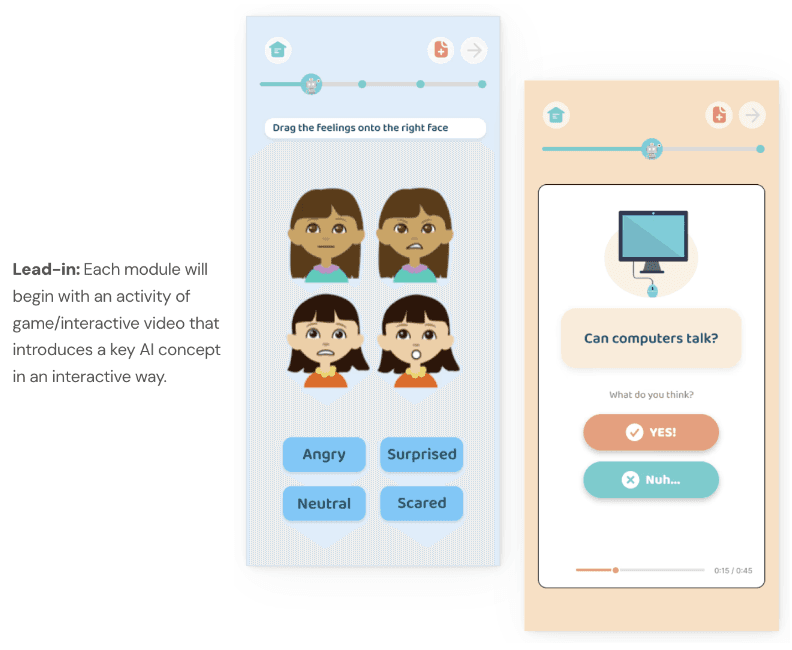


Cognitive load: chunking information with visual explanations


Interaction: high-frequency of interactions and immediate feedback.

[05. Metrics]
To evaluate whether AI + Me successfully turns a teacher-led curriculum into a "self-paced, playful learning experience that kids can complete on their own," these are the key metrics I would track in future usability testing.
